Guide
Varas to feet: converting Texas deed calls
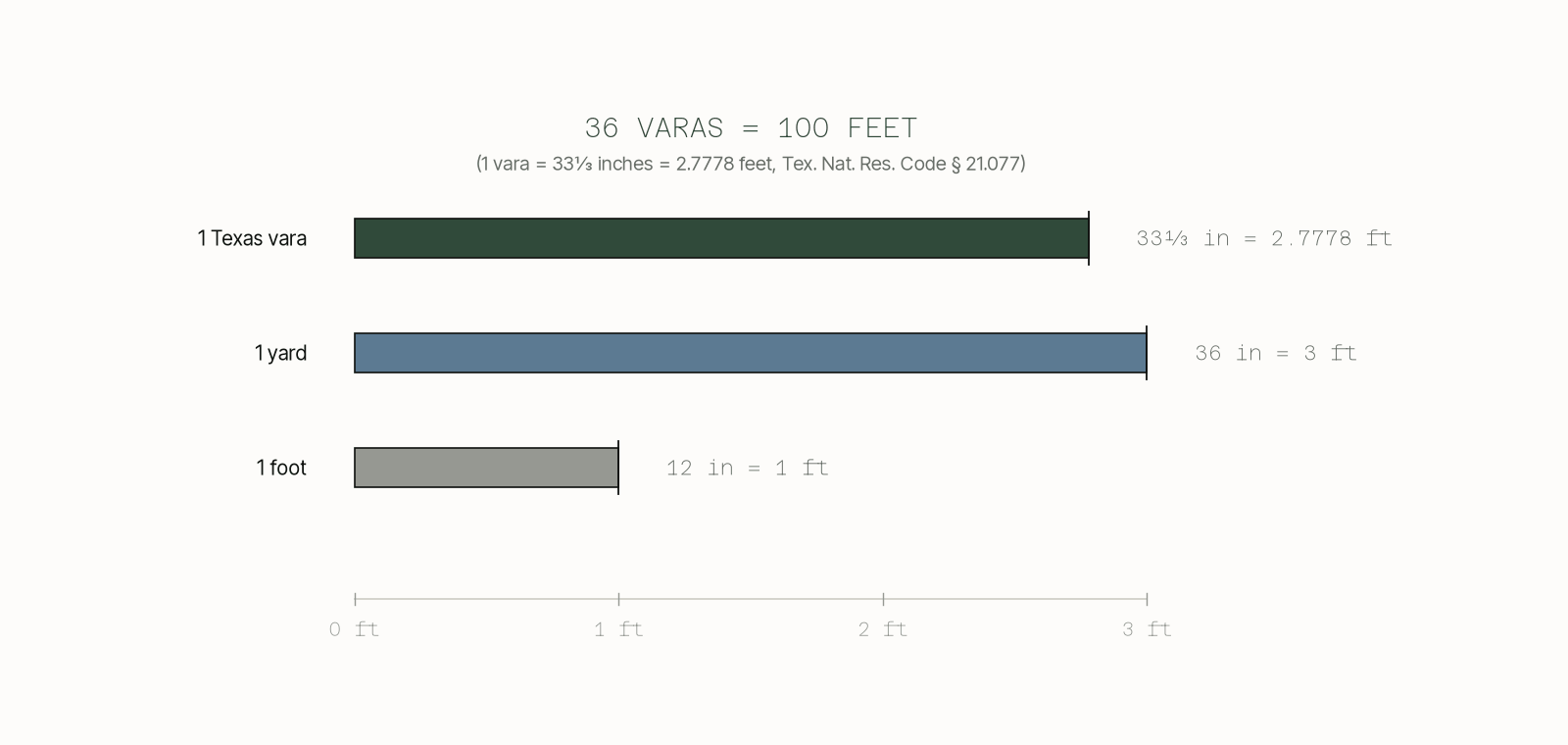
One Texas vara is 33 1/3 inches, or 2.7778 feet, and 36 varas work out to exactly 100 feet. Use the converter below for varas, feet, meters, chains and rods, and for square varas, acres, labors and leagues, or read on for the chart, the Texas standard, a worked deed call, and why old descriptions often don't close.
Updated November 21, 2026
What a vara is
The vara is a Spanish unit of length that came into Texas through Spanish and Mexican land grants, long before Texas was its own republic. Texas never fully converted its land records to feet, so vara calls still turn up in deeds, General Land Office field notes and old plats across the state.
The concentration is heaviest in South Texas. A large share of titles in the Eagle Ford Shale trace back to Spanish and Mexican land grants measured entirely in varas, and those original calls are still the starting point for tracing title on that ground today.
The Texas standard
Texas fixed the vara at 33 1/3 inches exactly, a figure that came out of General Land Office practice rather than any single founding document. The Texas Legislature set that figure in state statute, and it remains the legal definition today (Tex. Nat. Res. Code Sec. 21.077).
That 33 1/3-inch figure is specific to Texas. California, Arizona and Mexico used their own varas, each a little different from the Texas one and from each other, so a vara distance in a document from outside Texas needs that jurisdiction's own standard, not this one.
Why other vara converters disagree
Not every vara is the Texas vara, and that's the usual reason two converters give different answers for the same number of varas. The Spanish vara de Burgos measured 0.8359 meters, about 32.9 inches, and a Mexican vara measured about 32.97 inches - both shorter than the Texas figure. A calculator built on one of those, or on California's or Arizona's own vara, returns a different feet value for the same vara count, even though the math each one runs is correct for its own standard.
Texas settled the question for its own records in statute: 33 1/3 inches exactly (Tex. Nat. Res. Code Sec. 21.077). For a Texas deed call, that's the figure to use, not a generic or a Mexican one.
Varas to feet chart
Common values, run through the same 33 1/3-inch figure the calculator above uses:
| Varas | Feet (US survey ft) | Meters |
|---|---|---|
| 1 | 2.78 | 0.847 |
| 2 | 5.56 | 1.693 |
| 5 | 13.89 | 4.233 |
| 10 | 27.78 | 8.467 |
| 36 | 100.00 | 30.480 |
| 50 | 138.89 | 42.333 |
| 100 | 277.78 | 84.667 |
| 500 | 1,388.89 | 423.334 |
| 950 | 2,638.89 | 804.335 |
| 1,000 | 2,777.78 | 846.668 |
| 1,900 | 5,277.78 | 1,608.670 |
| 5,000 | 13,888.89 | 4,233.342 |
Feet are US survey feet (1 vara = 100/36 ft exactly). Meters use the US survey foot basis, 1 ft = 1200/3937 m.
Length, converted
These all follow from the same 33 1/3-inch figure:
- 1 vara = 33 1/3 inches = 2.7778 feet = 0.8467 meters
- 36 varas = 100 feet, exactly
- 1 chain (Gunter's) = 66 feet = 23.76 varas
- 1 rod = 16.5 feet = 5.94 varas
- 1 mile = 5,280 feet = 1,900.8 varas
Area: labors, leagues and acres
Spanish and Mexican grants in Texas were sized in units of area, not just length, and those units still show up in old grant and patent records:
| Unit | Square varas | Acres |
|---|---|---|
| 1 acre | 5,645.376 | 1 |
| 1 labor | 1,000,000 | 177.136 |
| 1 league (sitio, 25 labors) | 25,000,000 | 4,428.4 |
Computed from 1 vara = 100/36 feet exactly and 1 acre = 43,560 square feet.
- 1 acre = 43,560 square feet = 5,645.4 square varas
- 1 labor = 1,000,000 square varas, about 177.1 acres
- 1 league (sitio) = 25,000,000 square varas, about 4,428.4 acres, or 25 labors
- a quarter league runs about 1,107.1 acres
Reading a metes-and-bounds call
A metes-and-bounds description walks the perimeter of a tract one call at a time. It starts at a point of beginning, usually tied to a corner of the underlying survey, then gives a series of bearings (compass directions) and distances meant to walk the figure all the way back to that same starting point.
Here's a call built for illustration, referencing the abstract number that identifies the underlying survey: BEGINNING at an iron pin in the survey's west line, Abstract No. 212; THENCE North 10 degrees East, 300.0 varas to a point; THENCE South 80 degrees East, 150.0 varas to a point; THENCE South 10 degrees West, 300.0 varas to a point; THENCE North 80 degrees West, 150.0 varas to the PLACE OF BEGINNING, containing 7.97 acres, more or less.
Run the vara distances through the converter above and the same call reads in feet: North 10 degrees East, 833.33 feet; South 80 degrees East, 416.67 feet; South 10 degrees West, 833.33 feet; North 80 degrees West, 416.67 feet. The shape is identical. Only the units changed.
Why old descriptions don't close
Walk an old metes-and-bounds call on paper and it should arrive back at its point of beginning. In practice, older ones often miss by some margin, and that's a known feature of historic land records, not a defect in any one tract.
A few reasons show up again and again. Many old calls used magnetic bearings without recording the date, and magnetic north drifts over decades, so retracing the same bearing today points a little differently than it did originally. Monuments move or disappear entirely: a stake, a blazed tree or a pile of rocks set a century ago, with later re-measurements sometimes tied to a nearby stand-in instead. Long distances chained by hand across rough ground carried more error than short ones, and that error compounds across a multi-call description. And every re-conveyance since the original grant copies the same calls forward, so a single transcription slip becomes part of the record from that point on.
None of that means a given tract is wrong, only that reconciling an old description against the ground is its own specialized task, separate from converting its units.
Getting it into a modern GIS
Converting varas to feet solves the units problem, not the coordinates problem. A tract described in the 1800s still needs to land in a real coordinate system before it can sit next to anything else on a map, and Texas work runs on State Plane, in both the NAD27 and NAD83 datums. Those two can put the same corner tens of meters apart, so knowing which one a description or a client's shapefile uses matters as much as the vara-to-feet math.
Plotting it yourself, or having it drafted
Free deed plotters exist online, and for a quick check of whether a call looks closed, one of those is a reasonable place to start.
For a tract headed into a closing package, a data room, or anything that needs to hold up next to a title company's or a buyer's own records, that's usually a COGO deed plot or an Exhibit A boundary exhibit, drafted from the record rather than hand-plotted.
Embed this calculator
Drop this calculator into a blog post, a county resource page or anywhere else landmen look up varas, free to embed with credit.
Cite this tool: https://jbfieldservices.com/guides/varas-to-feet/
Embed code
<iframe src="https://jbfieldservices.com/embed/varas-to-feet/" title="Texas varas to feet calculator" width="100%" height="360" style="border:0;max-width:640px" loading="lazy"></iframe>
<p><a href="https://jbfieldservices.com/guides/varas-to-feet/">Varas to feet calculator</a> by JB Field Services</p>
FAQ
How many feet are in a vara?
A Texas vara is 2.7778 feet (33 1/3 inches). Varas outside Texas, in California, Arizona or Mexico, run slightly different lengths.
How many feet are in a Texas vara?
A Texas vara is exactly 33 1/3 inches, or 2.7778 feet. Thirty-six varas work out to exactly 100 feet.
How many varas are in an acre?
One acre equals 5,645.376 square varas, computed from the Texas vara at 33 1/3 inches and 43,560 square feet per acre.
What is 1 var equal to?
"Var" is usually a typo for vara. One Texas vara equals 33 1/3 inches, or about 2.78 feet.
Is a vara the same length everywhere?
No. Texas fixed its vara at 33 1/3 inches, but California, Arizona and Mexico used their own, slightly different lengths. A vara figure from outside Texas needs that jurisdiction's own standard, not the Texas one.
Do Texas land records still use varas?
Yes. Many original Texas land surveys, older deeds and General Land Office field notes are written entirely in varas, and some current instruments still carry those same calls forward.
Need the tract drafted, not just converted?
Send the deed call and we'll turn it into a COGO deed plot or an Exhibit A boundary exhibit, drafted from the record and ready for a closing package or data room.